

A roof engineered to last thirty years often gets torn off at fifteen. Not because it failed, but because nobody ever looked at it. That gap between what a roof can do and what it actually does is where money quietly disappears for Metro Atlanta homeowners.
I had the pleasure of speaking with Brad Strawbridge of Capital City Roofing on The Posner Property Perspective, where he shared what the trade taught him about protecting the one part of a house nobody thinks to check.
Here’s a preview of that episode:
Why I Had This Conversation
I have been selling homes in Metro Atlanta for over a decade, and the roof shows up at the worst possible moment almost every time. A buyer is days away from going under contract, or a seller is prepping to list, and suddenly the age of the shingles becomes the entire negotiation.
Past the ten-year mark, some carriers now come back with a prorated replacement cost instead of full coverage. That number blindsides people who had no warning it was coming.
Brad owns Capital City Roofing out of Alpharetta and runs residential and commercial crews across four markets. He sits on two National Roofing Contractors Association committees and on the boards of the National Roofing Apprenticeship Program and the Roofing Technology Think Tank.
I wanted a conversation with him because my clients deserve better information than whatever a stranger at the door is selling.
Watch the full episode here:
Why Georgia Puts the Burden on the Homeowner
Brad opened with a number that reframed the whole episode for me. Georgia has somewhere between 10,000 and 15,000 roofing companies, and there is no formal licensing for specialty contractors in this state.
No barrier to entry means anyone can start a roofing company tomorrow. The credential gap does not disappear. It simply moves onto the homeowner, whether they realize it or not.
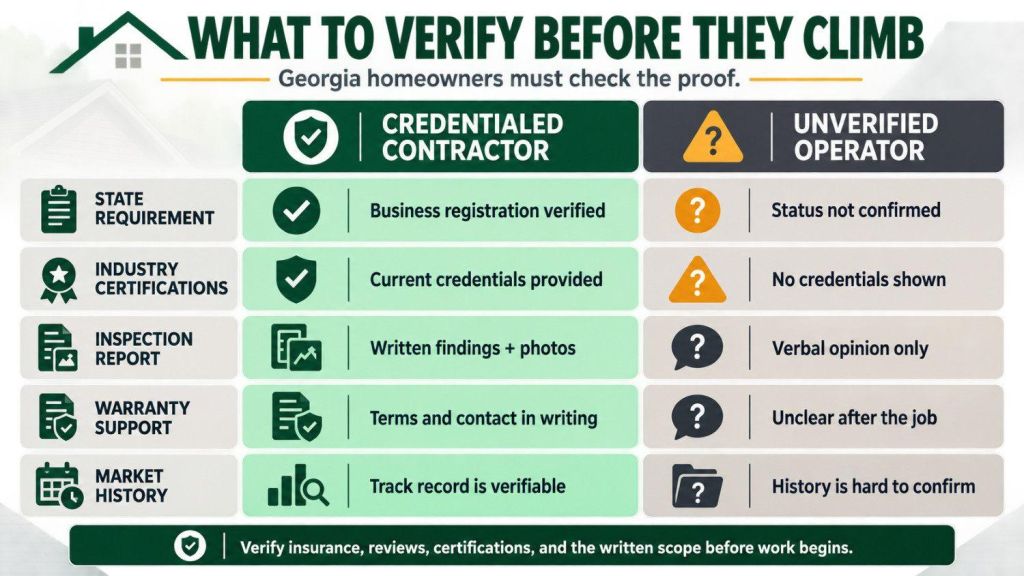
That gap is exactly why his 27-point roof inspection exists. It covers far more than shingles, and even the items outside his lane get photographed so the homeowner ends up holding a documented record instead of a verbal opinion.
For anyone weighing residential roofing services across Metro Atlanta, that documentation is the real product.
When a Repair Beats a Full Replacement
The part of our conversation I did not expect was Brad arguing against selling roofs.
“There’s a misconception that if a roofing company gets the opportunity to give an inspection, they automatically just want to sell a whole new roof. And a whole new roof isn’t always the answer, and that’s why our landfills are full of asphalt shingles right now. I’m about building value and helping to minimize cost for the clients. So if we can do a leak repair or we can do what I call a life extension, which would be a more involved maintenance application, keep the roof watertight and perhaps buy some time so that the homeowner or the building owner can save some money and put it in their budget.”
A life extension means walking the roof, sealing penetrations, and replacing only damaged shingles. It can buy three to five more years of watertight service while a family budgets for the real thing.
For my sellers, that changes the math on a listing entirely. The choice in roof repair vs. roof replacement is a strategy decision, not a foregone conclusion.
Why Insurance Claims Got So Much Harder
Five to seven years ago, an approval was close to automatic. Then opportunists flooded in, some companies manufactured damage on roofs they were invited onto, and carriers responded with sting operations and counter surveillance.
Now, the pendulum has swung the other way. Deductibles are being written as a percentage of home value, policies are being dropped, and legitimate damage is being denied.
The tactic Brad sees most with his commercial and multifamily clients is a carrier pulling historical satellite imagery, deciding a roof looks old, and issuing a 90-day replace-or-lose-coverage notice with no one ever setting foot on the property.
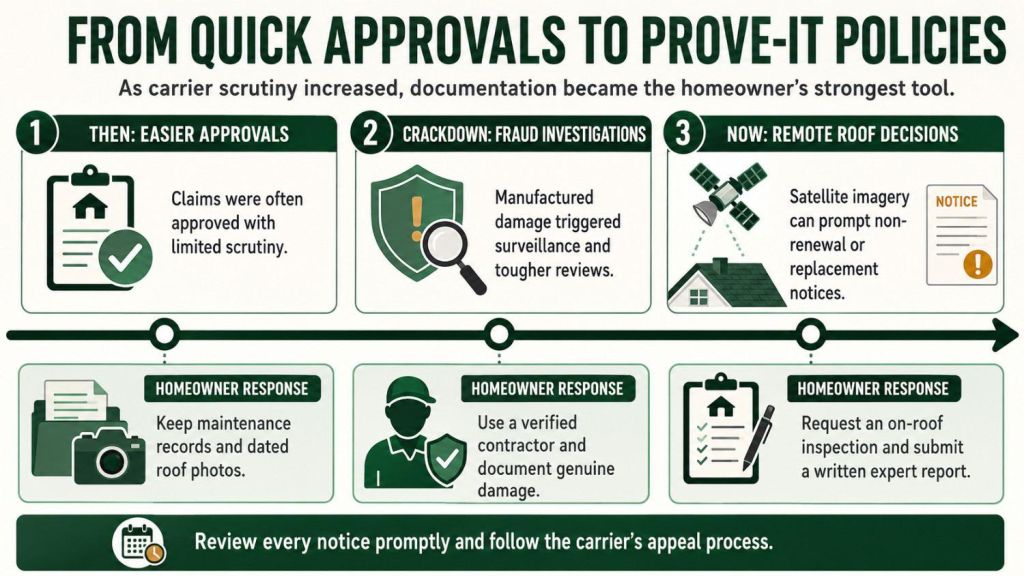
His counter is a written expert report sent back to the carrier. A roof insurance claim denial built on satellite images does not survive contact with a documented inspection from someone who actually climbed up there.
The Attic Problem Hiding Above Your Ceiling
Almost every attic Brad opens, unless the home is brand new, has droppings and debris worked into the blown-in insulation. That material circulates through the HVAC system, which puts it squarely in the healthy-home conversation I have with clients constantly.
“Most roofing problems, they’re not roofing problems. They’re communication and process problems. Because a lot of companies, they don’t have clear processes, they don’t communicate well, they don’t hold themselves accountable, and they don’t take care of their clients. And I hate to say it, but it’s true.”
The mistake he wants homeowners to avoid is spray foam applied directly to roof decking. It blocks the intake through the soffits and the exhaust through the ridge, so shingles never cool.
Petroleum-based shingles then blister, the protective granules shed, and the surface breaks down the way a road develops potholes. The relationship between attic ventilation and roof life is not a detail. It can cut a roof’s lifespan in half.
What Changed for Me After This Conversation
I have a service that checks my HVAC filters and coolant lines twice a year. In ten years of real estate, nobody had ever asked me whether anyone gets on the roof.
“An unmaintained roof may last 15 years if it’s installed correctly. A roof that’s maintained can last 30 or more. So I recommend a biannual maintenance plan. Twice a year, you’ll have somebody come out and actually get on the roof, and it does a couple of things. One, you have eyeballs on your roof, so that way you can become proactive instead of reactive.”
A roof maintenance plan catches the sealant that dry-rots off exposed ridge nail heads and the plumbing boots that are the number one leak area on any roof. It also produces a photo record that wins arguments with carriers a decade later.
I am recommending inspections to every client now, and it makes an excellent closing gift for investors and first-time buyers looking at homes for sale in Georgia. Thirty minutes with Brad Strawbridge of Capital City Roofing permanently changed how I advise people about the most expensive thing sitting on top of their house.
Want to hear my full conversation with Brad on doubling the life of your roof?
Frequently Asked Questions
How often should a roof be inspected?
Twice a year is the standard Brad recommends. On a brand new roof, once a year is reasonable, and the frequency should increase as the roof ages.
Does a new roof still need maintenance?
Yes. Sealant around ridge nail heads breaks down under UV exposure, and plumbing boots fail long before shingles do. Maintenance is what separates a 15-year roof from a 30-year roof.
What should I ask a roofing contractor before hiring?
Ask for certifications, verified reviews, proof of insurance, and a transparent written plan of action. Then fact-check the answers before anyone gets on your roof.
Apply as a Guest on The Posner Property Perspective
Every transaction touches somebody who knows one piece of this business better than the rest of us do. Inspectors, lenders, insurance specialists, contractors, and trades leaders all hold knowledge that buyers and sellers rarely get access to at the right moment.
If that describes your work, I would like you to apply to be a guest on the show and share it with our audience.
The Posner Property Perspective is produced by Icons of Real Estate, the #1 Real Estate Podcast Network. If you are a real estate professional, apply to be a guest speaker across the network!